Photographing Squirrel Monkey
Introduction
Squirrel monkeys are small, fast, and endlessly active. They live in large social groups — sometimes over a hundred individuals — and their constant movement, combined with the dense forest environment they inhabit, makes them one of the most technically challenging primate subjects to photograph. But their large, expressive eyes and inquisitive nature reward the patient photographer.
Understand the Animal
Squirrel monkeys are constantly in motion — foraging, grooming, playing, watching. They rarely stay still for more than a few seconds. This means your shooting style needs to be reactive: track, acquire focus, and fire in quick bursts when a moment presents itself.
When a squirrel monkey settles briefly on a branch, hands resting on a surface, eyes scanning — that is your window. These brief pauses produce the sharpest, most composed images. Learn to anticipate them.
Look Before You Shoot
The large eyes are your focal point. They are the most expressive feature of the animal, and they must be sharp. Use a single focus point and place it on the nearest eye. If the eyes aren't sharp, the image fails.
Forest light is challenging — dappled, high-contrast, and constantly shifting as the canopy moves. Look for moments when the monkey moves into a patch of clean, directional light. These brief pools of light produce the best results.
Composition Ideas
The Perched Portrait
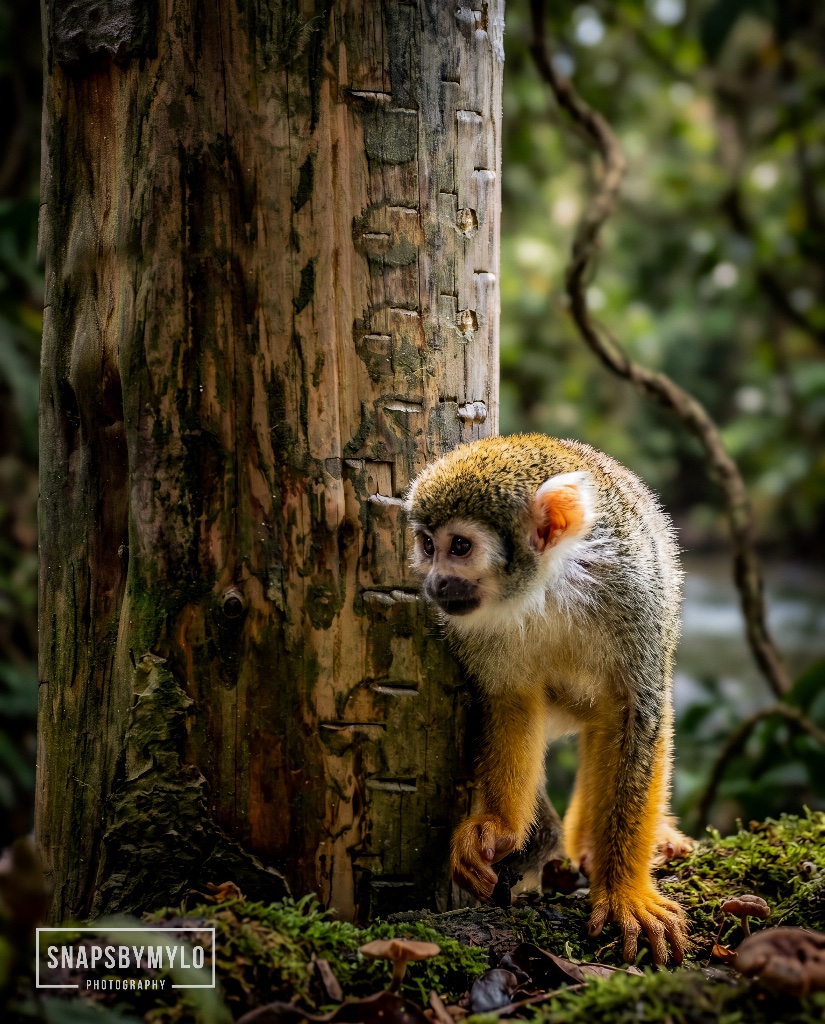
Look for: A squirrel monkey settled on a branch or mossy surface, hands resting, eyes wide, in warm directional light.
Why it works: This is the image that defines the species — the large eyes, the golden-orange fur, the alert, inquisitive expression. Patience is key — wait for the brief stillness.
Hands on Surface
Look for: When a squirrel monkey rests its hands on a branch or mossy surface, the posture creates a grounded, intimate composition.
Why it works: The hands are surprisingly human-like and their inclusion adds emotional resonance to the portrait. They create a visual anchor that connects the viewer to the subject.
Group Dynamics
Look for: Include multiple individuals in the frame — grooming, playing, or simply aware of each other.
Why it works: Squirrel monkeys live in large groups. Including multiple individuals tells the story of a social species that a solitary portrait cannot.