Photographing Snowy Owl
Introduction
Snowy owls are birds of the Arctic — they breed on the tundra and are active during daylight, an adaptation to the twenty-four-hour sun of the polar summer. As photographic subjects, they offer something rare in owl photography: the possibility of portraits in natural, directional light, with a bird that is alert, present, and looking back at you.
Understand the Animal
Snowy owls are diurnal. This is your advantage. Unlike most owls, which are nocturnal and difficult to photograph in good light, snowy owls are active during the day. In the Arctic summer, there is no night — the light is continuous, and the shooting windows are limited only by the owl's behaviour, not by the sun.
Snowy owls perch on elevated positions — hummocks, fence posts, buildings — to scan for prey. When the head swivels rapidly, the owl is tracking movement. When it takes off, it's usually low and fast, toward a prey item on the ground.
Look Before You Shoot
The white plumage is a metering challenge. Your camera will try to underexpose, turning the owl grey. Overexpose by one to one-and-a-half stops, or use spot metering on the face. Check your histogram — the white feathers should sit near the right edge without clipping.
The yellow eyes are your focal point. They are the single most striking feature of the bird, and they must be sharp. Use a single focus point and place it on the nearest eye.
Composition Ideas
The Front-Facing Portrait
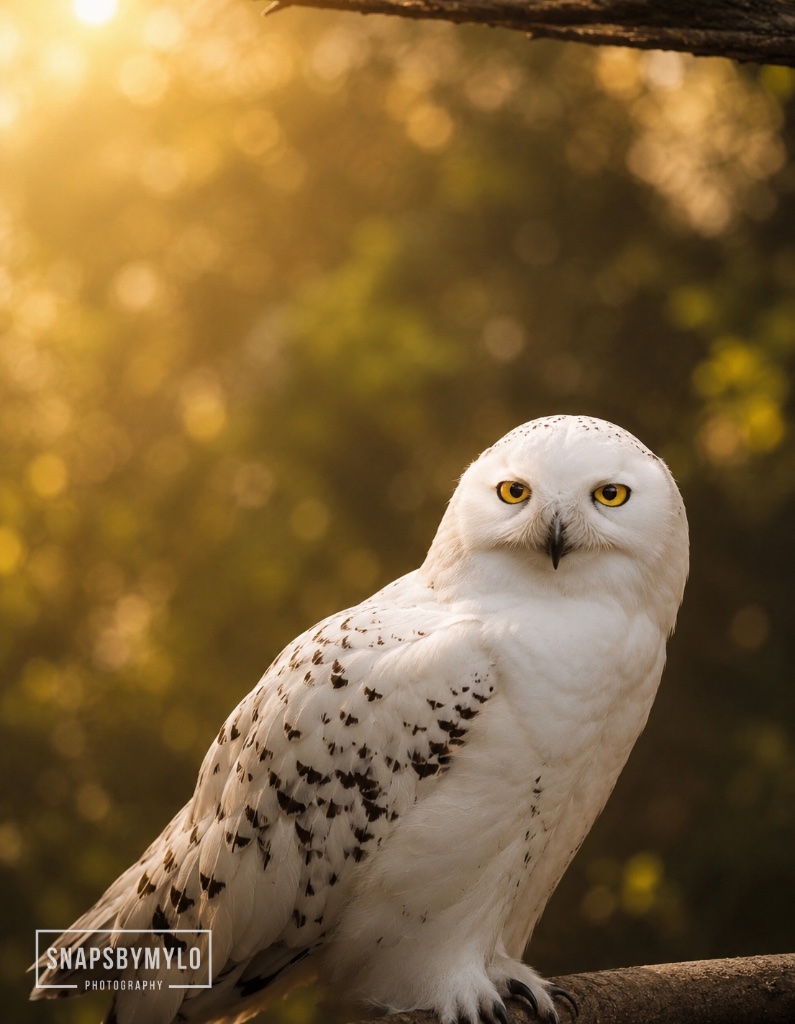
Look for: A snowy owl perched on a branch, facing directly toward the camera, bright yellow eyes locked onto the lens.
Why it works: The symmetry, the direct gaze, the contrast between white plumage and yellow eyes — it's one of the most powerful portraits in wildlife photography.
Environmental Tundra
Look for: Pull back and include the Arctic landscape. A snowy owl small in the frame, against the vast, flat, treeless tundra.
Why it works: This communicates the scale and isolation of this bird's world. The context is essential to understanding the species.
Flight at Ground Level
Look for: Snowy owls fly low when hunting. A flight shot at ground level, wings spread, gliding over the tundra.
Why it works: Pre-focus on a likely flight path and fire a burst when the owl launches. The low, flat flight posture is dynamic and rare.