Photographing Gibbon
Introduction
Gibbons are the acrobats of the primate world. They are the fastest and most agile of all tree-dwelling, non-flying mammals, capable of leaping up to fifteen metres between branches. As photographic subjects, they are challenging — fast, often high in the canopy, and difficult to track. But when you catch them in the right moment, the results are extraordinary.
Understand the Animal
Gibbons are arboreal. They brachiate — swing arm over arm through the canopy — and rarely descend to the ground. When they do come to ground, it's usually to cross a gap in the forest or to drink. These ground-level moments are rare and precious for a photographer.
Gibbon pairs sing. Their complex territorial calls carry for over two kilometres through the forest and are one of the most distinctive sounds of the Asian rainforest. If you hear them calling, they've revealed their position — move quietly toward the sound.
Look Before You Shoot
The forest canopy is a high-contrast nightmare. Dappled light, deep shadow, and bright sky create extreme dynamic range. Spot meter on the gibbon's face whenever possible.
Background separation is essential. A gibbon against a cluttered canopy of leaves and branches disappears. Look for the moment the gibbon moves to the edge of a branch, against open space or sky — this is when the form reads cleanly.
Composition Ideas
The Brachiating Swing
Look for: A gibbon mid-swing, arms extended between branches, body suspended in air. Pre-focus on a branch you expect the gibbon to swing toward.
Why it works: This is the defining image of the species. The body suspended in air, arms extended, captures the essence of what makes gibbons extraordinary.
Pair Behaviour
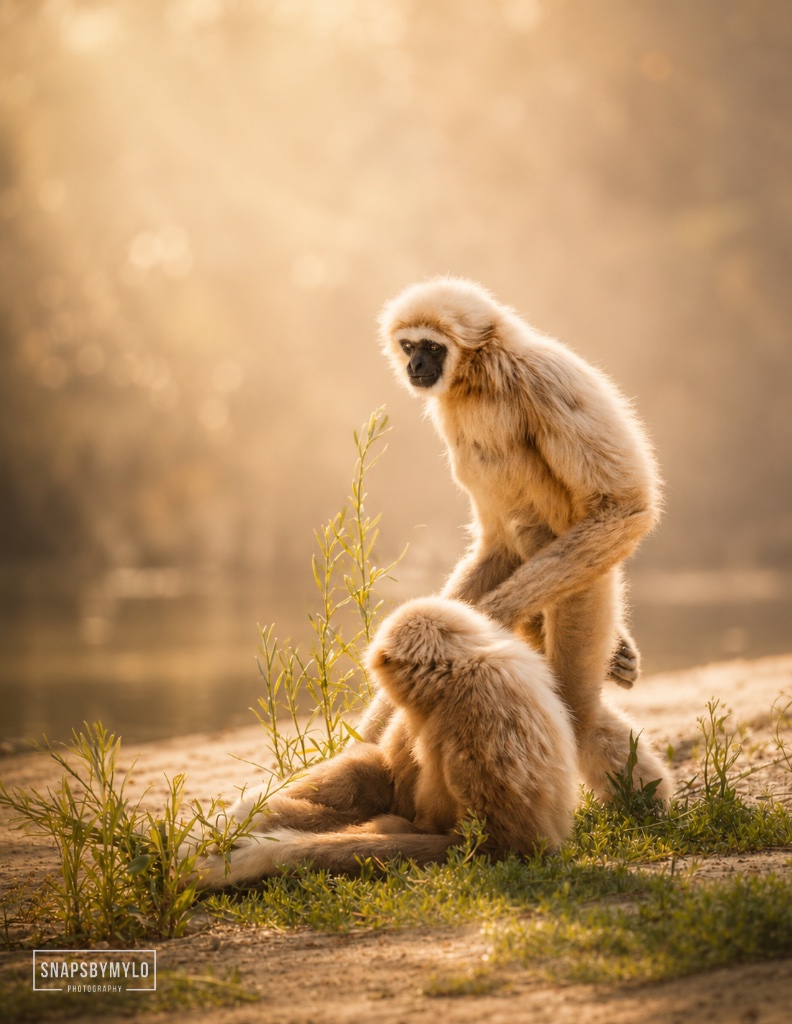
Look for: Two gibbons in frame together — grooming, resting near each other, or simply aware of each other's presence.
Why it works: Gibbons are monogamous and form strong pair bonds. Two gibbons together tells a story about social bonds that a solitary portrait cannot.
Ground-Level Encounter
Look for: When a gibbon descends to the ground, drop to eye level. A gibbon photographed at ground level, against the forest floor.
Why it works: This creates an intimate and unusual perspective of an animal that is almost never seen outside the canopy. The low angle gives the image a sense of discovery.