Photographing Flamingo
Introduction
Flamingos are nature's exercise in colour and form. The coral-to-pink plumage, the impossibly long neck, the stilt-like legs — every element is visually distinctive. As photographic subjects, they offer extraordinary opportunities for both graphic composition and behavioural storytelling, particularly when photographed in large flocks.
Understand the Animal
Flamingos are highly social, living in flocks that can number in the thousands. Their behaviour is synchronised — they feed together, display together, and fly together. Look for moments of collective movement within the flock.
The iconic one-legged stance is a thermoregulation behaviour, not a sign of injury. A flamingo standing on one leg is at rest. When it drops to two legs, it's about to move.
Look Before You Shoot
Water is your greatest asset. Flamingos feed in shallow lakes and lagoons, and the water surface provides reflections, backlighting effects, and a clean, uncluttered background. Get low to the water's surface for the strongest reflections.
The pink colouration is diet-derived — carotenoid pigments from algae and crustaceans. In good golden-hour light, the plumage glows with an intensity that seems artificial. Seek out backlight for maximum colour saturation.
Composition Ideas
The S-Curve Neck
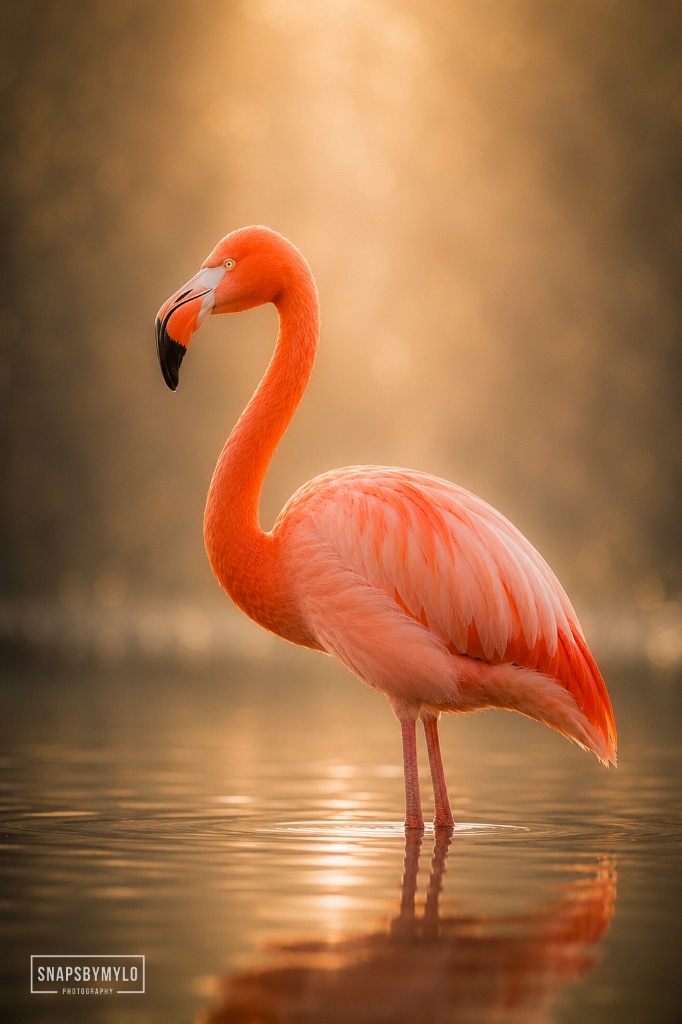
Look for: A single flamingo with its neck curved in the elegant S-shape, standing in reflective water.
Why it works: The neck forms a natural compositional line that guides the eye. Shot tight, the form isolated against the water, it becomes a study in pure shape and colour.
Flock Patterns
Look for: From a distance, a flock of flamingos creates a dense field of pink. Look for patterns — lines, clusters, movement waves.
Why it works: These patterns emerge from the collective. Aerial or elevated perspectives reveal them best, turning a mass of birds into a graphic composition.
Reflections and Backlight
Look for: Get low. A flamingo and its reflection, backlit at golden hour, with the water catching the warm light.
Why it works: This produces one of the most visually rich images available in wildlife photography. The doubled form, the warm light, the reflective water — everything works together.